AI Supply Chain Vendor Reality Check -Part 3
How the AI infrastructure crunch shows up in honest vendor conversations.st description.
12/20/20256 min read

Vendor Reality Check
How the AI infrastructure crunch shows up in honest vendor conversations.
The "Not a Hit Piece" Disclaimer
Let's get this out of the way: I'm not here to trash your vendors.
Dell, Pure, Cisco, Azure—they aren't villains twirling mustaches and hoarding GPUs to ruin your Q2 project. They are rational actors in a physics-constrained market. They are dealing with the same upstream shortages (NAND, power, CoWoS packaging) that you are, just at a scale where the zeros on the purchase orders are terrifying.
But their problems become your problems. And their marketing spin often obscures the operational reality.
You don't need another slide deck about "AI-ready infrastructure." You need to know why your lead time just doubled and why your quote went up 12%.
Here is the unvarnished reality for the six vendors dominating your datacenter.
Dell Technologies
The Vibe: "We are the AI Factory."
The Reality: The factory is running 24/7, but the line is out the door.
Where AI hits them:
Dell has an $18.4 billion backlog for AI servers (specifically the XE9680). That backlog is growing faster than they can ship. Why? Because an XE9680 isn't just a metal box; it's a complex integration of constrained GPUs, high-end smart NICs, and specialized power delivery.
What you’ll see:
The "Lumpy" Lead Time: If you're ordering standard PowerEdge servers, you're mostly fine—unless your configuration uses the same high-density DDR5 or enterprise SSDs that the AI monsters are eating. Then you wait.
The "Supply-First" Price: Dell is prioritizing supply security over low cost. They are paying premiums to secure memory and storage components. They will pass that cost to you. Expect quotes to tick up, not down.
Allocation Games: If you aren't a "strategic" AI customer, your order for 50 GPU servers sits behind the hyperscaler ordering 5,000.
Defense move: Don't let them bundle you into a waitlist. If you need standard compute, audit your BOM (Bill of Materials) for shared choke-point components. Swap that 30TB NVMe drive for a more available SKU and watch your lead time drop by 8 weeks.
Pure Storage
The Vibe: "Hard drives are dead. Long live flash."
The Reality: Flash is expensive again, and they are fighting physics.
Where AI hits them:
Pure's entire thesis is "all-flash, all the time." That worked great when NAND prices were crashing in 2023. Now? NAND prices are up double digits. Hyperscalers are buying enterprise SSDs by the pallet for AI training lakes.
What you’ll see:
Margin Protection: Pure is absorbing some costs to kill HDDs (via the FlashBladeE), but they can't keep eating it forever. Expect "non-negotiable" uplifts on renewals or new capacity.
The QLC Push: They will aggressively steer you toward QLC (Quad-Level Cell) drives. It's cheaper for them and available. If you insist on TLC (Triple-Level Cell) for high-performance workloads, prepare to pay a "legacy tax."
"AI Ready" Upsell: Every meeting will pivot to how your storage needs to be "AI Ready" (read: faster, more expensive, and proprietary).
Defense move: Lock in pricing for your next 12 months of capacity expansion now. If you have a renewal in 2026, negotiate it now. NAND isn't getting cheaper this year.
Cohesity
The Vibe: "We aren't just backups anymore. We are an AI-powered data security."
The Reality: They are digesting the Veritas acquisition and hoping you buy the "Gaia" AI assistant.
Where AI hits them:
Cohesity is a software company, but its customers run on hardware. If storage costs rise, your backup target costs will increase as well. If you use their SaaS offering, their backend cloud costs are rising, which puts upward pressure on your price per TB.
What you’ll see:
The Veritas Distraction: They are merging with a massive legacy player. Sales reps will be confused. Account maps will shift. Use the chaos to your advantage to secure a price freeze.
The "Gaia" Tax: They want you to pay for their AI assistant to "chat with your backups." It's cool tech, but verify if it solves a business problem or just increases your ARR (Annual Recurring Revenue).
Defense move: Separate the software license from the storage cost. If you bring your own hardware (Cisco/HPE/Dell), manage that supply chain yourself. If you use their SaaS, demand a multi-year price lock before they pass on the cloud storage hikes.
Nutanix
The Vibe: "VMware is evil. Come to our safe harbor."
The Reality: The software works, but it requires servers to run.
Where AI hits them:
Nutanix is riding the "Escape Broadcom" wave, but they are tethered to hardware partners (Dell, HPE, Cisco, Lenovo). If Dell is backlogged, your Nutanix project is backlogged.
What you’ll see:
GPT-in-a-Box: This is their turnkey AI play. It's valid, but it relies on GPU availability. If they can't secure the GPUs from their hardware partners, it's just a slide deck.
License Portability: They are leaning hard on "run anywhere." This is your leverage. Use it to negotiate better hardware terms by threatening to run on bare-metal cloud if on-prem gear is delayed.
Defense move: Don't sign the software deal until the hardware delivery date is confirmed. A software license burning shelf time while you wait 4 months for servers is a waste of capital.
Azure (Microsoft)
The Vibe: "Infinite scale. Just bring your credit card."
The Reality: "The region is full. Try North Central US."
Where AI hits them:
Microsoft is building AI datacenters faster than anyone, but it is also consuming capacity faster than anyone. OpenAI's training jobs are massive.
What you’ll see:
Ghost Capacity: The portal says the quota is approved. You try to spin up the VMs. Deployment fails. "Capacity constraints in this region."
The Reservation Squeeze: Azure is tightening rules on reserved instances. Expect stricter terms and potentially higher commitment requirements to secure access to high-demand SKUs (such as GPU/AI instances).
"Steering": Your account team will strongly suggest you deploy in new, obscure regions. "Why not run that production workload in West US 3?" (Because latency, Bob. That's why.)
Defense move: Stop trusting "On-Demand" for anything critical. If you don't have a Reservation or a Capacity Reservation Group, you don't have infrastructure; you have a gambling habit.
Cisco
The Vibe: "Supply chain shortages are history."
The Reality: For the switch, yes. For the optics that make it useful? Maybe not.
Where AI hits them:
Cisco is pushing "Hyperfabric" for AI. But the optical transceivers (800G, 400G) needed to light up those networks are the single tightest commodity in the world right now.
What you’ll see:
The Switch is Fast, The Optic is Slow: You'll get the Catalyst switches in 4 weeks. You might wait 6 months for the high-density optics. A switch without optics is a very expensive doorstop.
Price Hikes on Glass: Third-party optics are looking attractive, but Cisco will FUD (Fear, Uncertainty, Doubt) you about compatibility.
Defense move: Decouple the optics order from the switch order. Verify lead times for both line items independently. And seriously validate third-party optics for non-core layers. The markup on OEM optics is offensive.
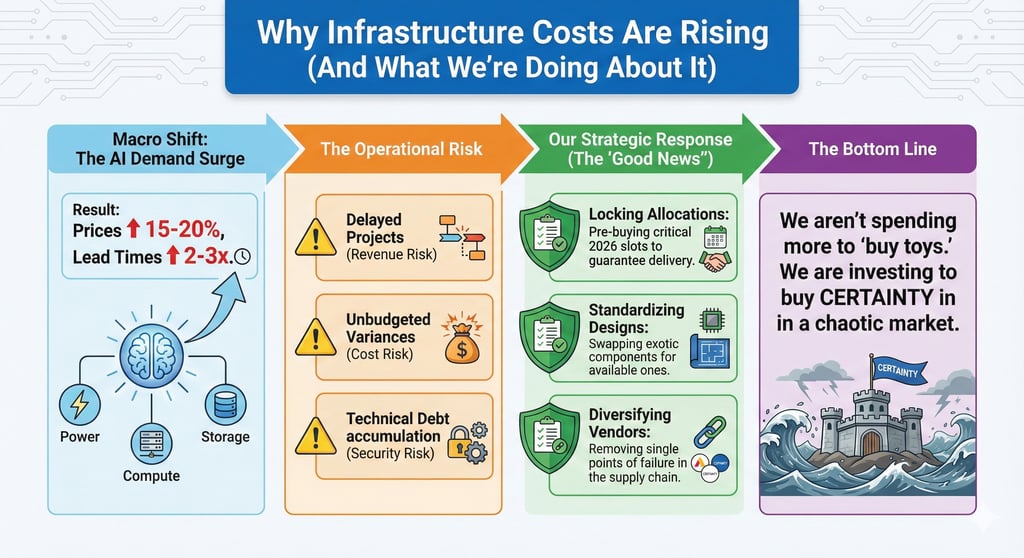
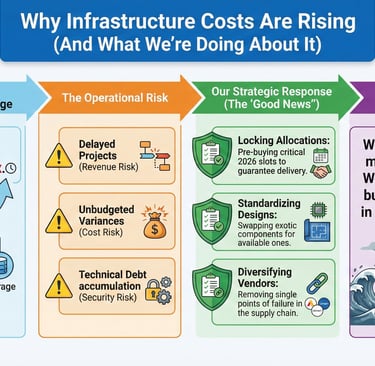
Cheat Sheet: Visualizing the Squeeze
Since you can't paste a blog post into a board presentation, here are two one-pagers to screenshot and drop into your next deck.
Final Thoughts: Be the Adult in the Room
The AI hype cycle is loud. Vendors are noisy. The supply chain is messy.
Your job isn't to fix the global semiconductor market. Your job is to build a shield around your enterprise so that the chaos outside doesn't spill into the chaos inside.
Talk to your vendors. Ask the hard questions about backlog and allocation. Ignore the "AI-ready" marketing fluff and look at the BOM lead times.
And when the CFO asks why you need to sign a commitment for hardware that won't arrive for six months, tell them: "Because I'd rather explain a prepayment today than explain a missed revenue target next year."
Good luck. You've got this.
This is Part 3 of a 3-part series on the AI hardware supply chain problem—what really happens after the sales pitch, how vendors are managing scarcity behind the scenes, and where enterprise leverage actually still exists.
If Part 1 explained how the market broke, and Part 2 showed how disciplined enterprises can survive it.