
The Strategic Framework for Not Dying Badly: A Deep Dive into Medicine 3.0
HEALTH
2/11/202610 min read
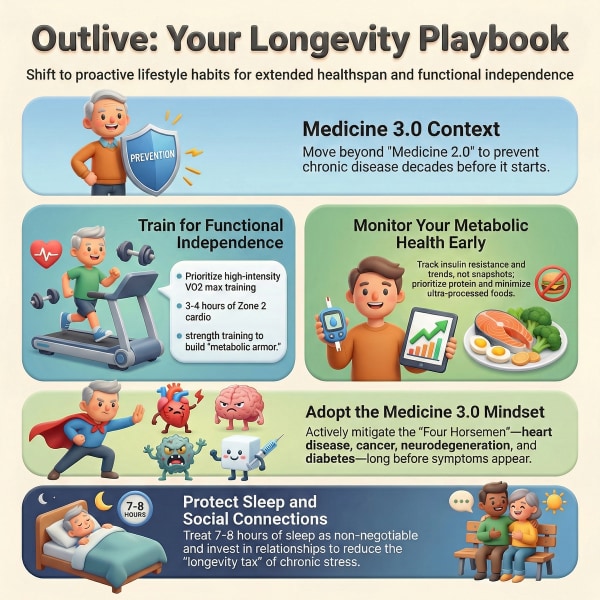
The Strategic Framework for Not Dying Badly: A Deep Dive into Medicine 3.0
This is not medical advice; it’s an amateur biohacker’s field notes from trying to cheat the actuarial tables. Copy anything in here without talking to a real doctor, and you’re basically speedrunning the morbidity curve on hard mode.
The Slowly Deflating Parade Float
Look around. People are “living longer” the way an old iPhone “still works” at 3% battery and permanent low-power mode.
They’re alive, technically. They’re also one bad fall away from the uninstall button.
That’s the modern aging experience. You don’t drop dead in your 60s. You turn into what Peter Attia calls a “slowly deflating parade float” in your 70s and 80s—air leaking out, color fading, still technically rolling down the street.
Medicine 2.0 calls this a win.
Medicine 2.0 is the system you live in right now: heroic, expensive, and mostly designed to keep you from dying today while ignoring the slow-motion car crash that started 30 years ago.
It’s great at bullets, infections, and car accidents, and terrible at the boring chronic stuff that actually kills you.
Translation: the system will rush to save you after you’re broken, but does almost nothing to keep you from breaking in the first place.
You are the car that only sees a mechanic once the engine seizes on the freeway.
Medicine 3.0 says that’s idiotic.
Instead of waiting for the check-engine light, it treats your body like a long-term risk portfolio—monitored, managed, rebalanced, and aggressively defended before something explodes.
Here’s the deal. This isn’t a wellness blog about vibes and herbal tea.
It’s a strategic framework for not dying badly: exercise, nutrition, sleep, emotional health, and data—so you can actually do things at 90 instead of identifying relatives by smell.
You’re training for what Attia calls the “Centenarian Decathlon”: the specific physical tasks you still want to perform at 100.
Not a metaphor. Actual tasks. Groceries. Grandkids. Stairs. Toilets without handles.
Sound uncomfortable? Good. That means you’re paying attention.
Healthspan vs Lifespan: The Real Scoreboard
Here’s the first uncomfortable truth: the number on your death certificate is the least interesting metric.
That’s the lifespan, how long the software runs before final shutdown.
Healthspan is everything that happens before the spinning wheel of death.
It’s your strength, cognition, mobility, and emotional stability, the part where you still recognize people and can stand up without making a small noise and a bigger face.
The goal of Medicine 3.0 isn’t immortality.
The goal is “compressing morbidity,” shrinking the window of time when your life turns into a slow, expensive medical hostage situation.
Picture two graphs.
Graph one: the classic slow slope down from 60, followed by ten years of walkers, drugs, diaper-level dignity hits, and hospital bracelets.
Graph two: you function at a high level until late life, then drop fast and clean.
You want graph two. Your family wants graph two even more.
Standing in the way are the Four Horsemen of “this is how you actually die”: cardiovascular disease, cancer, neurodegenerative disease, and metabolic dysfunction.
Heart disease is the silent favorite, quietly stacking plaque for decades while your doctor tells you your cholesterol is “fine for your age.”
Cancer is what happens when cellular photocopying starts spitting out bad duplicates, and no one hits the stop.
Neurodegeneration is losing you before losing your body, Alzheimer’s, Parkinson’s, the slow erasure of identity.
Then there’s metabolic dysfunction: insulin resistance, visceral fat, fatty liver, the upstream sludge that powers the other three killers.
If the Four Horsemen are the assassins, metabolic dysfunction is the guy who unlocks the back door and turns off the cameras.
Medicine 3.0 is about pushing all of that as far to the right on the timeline as possible.
Not “no risk.” Just “stack the odds so death has to work for it.”
The Centenarian Decathlon: Training for Future You
Here’s the thought experiment that should ruin your next lazy Sunday.
Imagine yourself at 100. Not the fantasy version. The real one.
List what you still want to be able to do.
Not “run an ultra.” Think basic: get off the floor. Carry groceries. Pick up a grandkid. Lift your own luggage. Walk up stairs without needing a nap and a priest.
This is the Centenarian Decathlon, a personal list of 10 or so physical tasks that will define whether your last decade is freedom or captivity.
It’s not an actual race; it’s a stress test for the future hardware that is your body.
Now comes the fun part: backcasting.
You don’t start training for those events at 90 when your muscle mass has already been foreclosed on.
You start now, then work backward from what you want to do at 100 to what that implies at 80, 60, 40, 30.
Here’s the thing: physical capacity decays whether you like it or not.
Muscle strength drops roughly 8–17% per decade as you age.
Translation: if you want to confidently lift a 30-pound grandkid at 80, you’d better be easily moving 50–60 pounds now, because decay is not optional.
The game is not “maintain where you are.”
The game is “build a massive reserve so the inevitable loss still leaves you functional.”
Think of it like a margin of safety in investing.
Either you overbuild now, or you underperform later, except this portfolio is your ability to wipe your own ass at 95.
You’re not training for abs.
You’re training to not need a handler.
Exercise: The Most Powerful Drug You’re Too Lazy to Take
If exercise were a pill, it would be unethical not to prescribe it.
Instead, it’s work, so most people skip the only intervention that meaningfully rewrites their risk profile.
Medicine 3.0 treats exercise as primary prevention, not an optional side quest.
Forget aesthetics. This is metabolic armor, cognitive insurance, and fall protection rolled into one miserable, sweaty practice.
Here’s the short list of what matters: cardio efficiency, peak aerobic output, strength, and stability.
Miss one, and your future self sends you hate mail.
Cardio Efficiency: Zone 2, The Boring Miracle
Zone 2 is the “conversational pace” zone, roughly 60–70% of your max heart rate.
You can talk, but you’d rather not deliver a TED talk.
This is where mitochondrial magic happens.
Zone 2 work trains your cells to use fat and fuel more efficiently, improves metabolic flexibility, and protects against mitochondrial dysfunction that links to cancer and dementia.
You want 3–4 hours per week here.
Not once, not “when life calms down,” not “after this project ships.”
Translation: long, boring cardio is not optional background noise.
It’s the quiet process that lets every cell in your body run cleaner under load.
Think about that next time you tell yourself walking from the couch to the fridge counts as “steps.”
Peak Output: VO2 Max, Your Real Credit Score
VO2 max, your peak oxygen consumption during intense exercise, is the single strongest predictor of all-cause mortality.
From “low” to “average,” your risk of dying plummets by around 50%.
Read that again.
Not a fancy supplement. Not a new drug. Just not being bottom-tier in cardio capacity cuts your mortality odds in half.
Training this sucks.
It’s supposed to.
Typical protocol: short, brutal intervals.
Example: four-minute hard efforts with recovery between, repeated enough times that you start questioning your life choices.
You should feel uncomfortable. You should not feel “refreshed.”
You are teaching your body to function at the edge.
When real life pushes you to the stairs, emergencies, or illness, this is the difference between “winded but fine” and “call an ambulance.”
Strength: Muscle as Survival Hardware
Sarcopenia—the age-related loss of muscle is the silent repo man of independence.
You don’t notice it until everything feels heavier and you “just don’t move as well as you used to.”
Medicine 3.0 treats muscle as an organ of longevity.
More muscle means better glucose disposal, higher metabolic rate, better balance, and more physical options as you age.
Key movements matter more than fancy equipment.
You want a strong grip (shockingly predictive of overall robustness), solid hip hinging (deadlifts, squats), and competent pulling (rows, pull-ups, or whatever scaled version doesn’t kill you).
You are training patterns, not just muscles.
Carry things. Pick things up. Put things overhead. Get off the floor using as little help as possible.
This isn’t cosplay fitness.
These are the reps for your Centenarian Decathlon events.
Stability: The System That Keeps You Off the Ground
Here’s a fun stat: falls are a leading cause of death after 65.
Not cancer. Not some sci-fi disease. Gravity.
Strength without stability is a lawsuit.
So Medicine 3.0 treats stability as the foundation, not an accessory.
That means training balance, coordination, and control: Dynamic Neuromuscular Stabilization patterns, foot strength work (“toe yoga”), and learning to create proper intra-abdominal pressure so your spine doesn’t fold like cheap lawn furniture under load.
You train this before you stack heavy weights.
Otherwise, you’re just optimally preparing your body for a spectacular failure.
Think about that next time you skip warmups to max deadlift your lingering emotional trauma.
Nutrition: Biochemistry, Not Religion
Nutrition discourse is a dumpster fire.
People pick a diet like a political party, tattoo it on their soul, and then scream at each other on the internet.
Medicine 3.0 wants none of that.
It ignores keto vs vegan vs carnivore as belief systems and looks at nutritional biochemistry instead: what actually happens to your metabolism over decades.
Here’s the thing: most aging adults undereat protein.
Then they’re shocked when their muscle mass disappears like a bad SPAC.
Protein is king if you care about maintaining the hardware you just trained in the gym.
No muscle, no strength. No strength, no Centenarian Decathlon.
Then there’s metabolic health.
The real target is insulin, not just glucose.
Insulin resistance isn’t a light switch.
It’s a dimmer sliding up across years and decades, quietly wrecking tissues and pathways long before someone slaps “type 2 diabetes” in your chart.
Ultra-processed foods are basically a direct-messaging system between your reward circuits and your waistline.
You don’t “avoid them for purity.” You minimize them because they hijack satiety, drive overconsumption, and keep your metabolism living in a permanent error state.
Same story across every aisle in the grocery store: the more engineered the food, the more aggressively it attacks the systems you’re trying to protect.
You’re not weak. You’re outgunned.
So you design an environment where whole or minimally processed foods are the default, protein is prioritized, and carbs and fats are tools, not ideologies.
That’s not sexy. It just works.
Sleep and Emotional Health: The Stuff You Pretend You Can Out-Hustle
You cannot out-exercise bad sleep.
You cannot out-diet chronic stress.
Sleep is neurological maintenance.
It’s when the brain clears metabolic waste, consolidates memory, repairs systems, and quietly keeps you from turning into a cognitively-impaired raccoon.
You’re not “grinding.”
You’re taxing your future with compounding interest.
Then there’s emotional health, the factor everyone ignores until life collapses.
Why live to 100 if you’re miserable, isolated, or numb?
Chronic stress and cortisol aren’t just “bad vibes.”
They’re a straight-up longevity tax: wrecking insulin sensitivity, blood pressure, visceral fat, and your willingness to do the work required to stay alive.
Relationships and purpose are not soft bonuses.
They’re biological input variables in your actual survival model, not lines in a Hallmark card.
You want a reason to get out of bed, people who would miss you, and routines that dump stress instead of marinating you in it.
Otherwise, you’re just extending lifespan on a life you don’t want.
Think about that next time you treat burnout like a personality trait instead of a solvable system problem.
Data and Early Detection: Stop Benchmarking Against a Sick Herd
“Normal” ranges on labs are based on the general population.
The general population is not well.
Translation: if your doctor says “this is normal for your age,” what they really mean is “you’re decaying at the average rate of a society that dies slowly and expensively.”
That is not the bar you want.
Medicine 3.0 obsesses over early detection and better metrics.
Not waiting for disease to appear, hunting for the invisible upstream signals.
On the lipid side, ApoB becomes a primary character.
It’s a more accurate measure of atherogenic particles than the standard LDL everyone fixates on.
Lp(a) matters too a genetically driven risk factor that tells you if your cardiovascular gun is pre-loaded.
You can’t change that gene, but you absolutely can change the environment it lives in.
Metabolically, fasting insulin is your early-warning radar.
Glucose is the lagging indicator—the fire you see after the building’s already lit.
Physically, tools like DEXA scans show you bone density and visceral fat—the “hidden fat” marinating your organs while your mirror lies to you.
Again, this is upstream data, not vibes.
Then there’s genetics.
Genetics loads the gun; environment pulls the trigger.
Family history isn’t a sentence.
It’s a risk model telling you where to fortify first.
You don’t wait for the disease to introduce itself.
You go looking for its footprints in your labs, scans, and history, then build countermeasures decades before the ambush.
Start Now Or Enjoy the Crash
Medicine 3.0 is a full operating system swap.
From reactive patching to proactive risk management.
You stop thinking in terms of “do I have a diagnosis?” and start thinking like: “what will this choice do to 80-year-old me?”
You don’t eliminate risk. You tilt the odds.
That tilt costs something.
Time. Discipline. Boring cardio. Heavy lifts. Earlier bedtimes. Hard conversations. Less dopamine from junk food and doom-scrolling.
The alternative costs more.
Years of disability, cognitive loss, medical debt, and being physically alive but functionally sidelined.
Here’s the kicker: it’s never too late to improve the trajectory, but it’s always easier today than it will be later.
Every year you delay, you compound your problems.
You don’t need a full protocol tomorrow morning.
You need one concrete move: book a VO2 max test, start 3 hours of Zone 2 this week, schedule a DEXA, lift something heavier than your laptop, or get bloodwork that actually looks at ApoB and fasting insulin.
Your 80-year-old self is not hypothetical.
They are waiting, silently, for the choices you make this year.
You can build a body that lasts a century or ride Medicine 2.0 into a slow-motion failure.
Either way, the bill comes due.
Enjoy that decision.
Sources & Further Reading
Primary Text
Attia, Peter, and Bill Gifford. Outlive: The Science and Art of Longevity. Harmony/Rodale, 2023.
Articles & Reviews
Ballinger, Brandon. "The biomarkers recommended by Peter Attia in Outlive." Empirical Health, October 11, 2025.
Bueckert, Sydney. "Peter Attia’s Workout Routine: How to Work Out to Live Longer." Hone Health, April 9, 2024 (Updated May 23, 2025).
Garrity, Tanner. "The 'Centenarian Decathlon' Is An Excellent Longevity Checklist." InsideHook, May 11, 2023.
Mann, Graham. "Outlive Summary: Beat the 4 Horsemen of Death with Medicine 3.0." Graham Mann Blog, Updated Jan 2026.
Stroup, Bobby. "Outlive by Peter Attia: A Book Review." Petrie-Flom Center (Harvard Law School), March 5, 2024.