
Understanding the Next Labor Shock
Explore the complexities of the labor market in the age of AI. Discover how job market trends reveal a quieter, more damaging shift than expected, as many face hiring freezes and a split in opportunities. Learn what this means for the future of work.
3/6/202612 min read
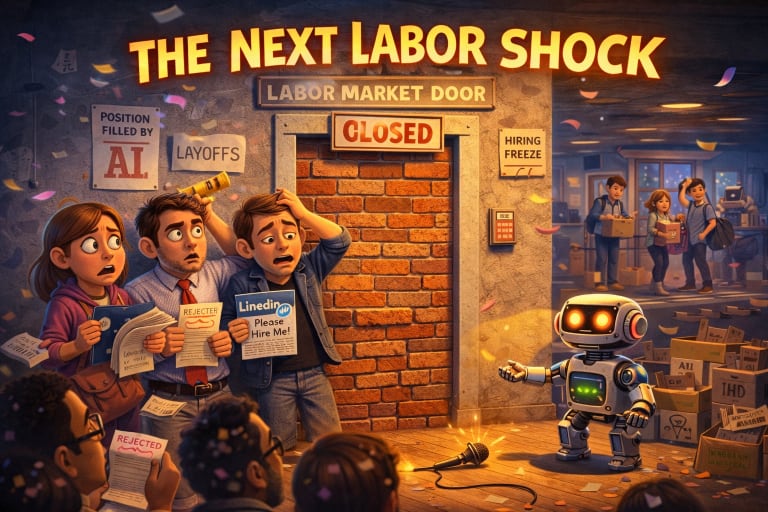
The Next Labor Shock
AI Isn't Replacing Your Job. It's Replacing the Door That Led to It.
Everyone wants a clean story about AI and jobs.
Either the robots take everything and civilization fractures, or the economy adapts, new roles emerge, and we all get better jobs that didn't exist before. History on our side. Progress inevitable. Don't worry about it.
Neither version is right.
What's actually happening is quieter, messier, and, in some ways, more damaging than either headline suggests, because it doesn't look like a crisis. It looks like a hiring freeze. A team that stops backfilling. A job posting that goes up, then disappears. A cohort of graduates who apply and apply and apply and hear almost nothing back.
The labor market is splitting.
The fracture line runs right through the middle.
And the people standing on the wrong side of it mostly don't know yet.
The Number Nobody Is Saying Loudly Enough
Workers aged 22 to 25 in the most AI-exposed occupations have experienced a 13% decline in employment since ChatGPT launched in late 2022.
That figure comes from the Federal Reserve Bank of Dallas.
Sit with that. Not a layoff wave. Not a mass firing event with a news cycle and a congressional hearing. Just a quiet, sustained contraction in hiring is invisible to anyone who isn't actively looking for a job and being told, again and again, that there isn't one.
The economy didn't fire these people.
It just stopped letting them in.
And that distinction matters more than most analysts want to admit because a layoff is visible, documented, and politically legible. A hiring freeze is none of those things. There's no severance. No press release. No HR paperwork.
Just a door that used to open and now doesn't.
Why Companies Are Moving Right Now
(Hint: It's Not Altruism)
The popular narrative says companies are adopting AI because it's transformative.
The financial narrative says they're adopting it because the math of labor finally broke in their favor.
Consider the infrastructure cost side. Hyperscaler demand for compute has driven up the price of the entire underlying stack: GPUs, memory bandwidth, power capacity, and cooling infrastructure. Companies building AI systems are spending at a scale that would have looked delusional four years ago.
That investment has to pay off somewhere.
The obvious pressure valve is headcount.
But there's a second layer that gets less coverage. Companies aren't just chasing AI's upside; they're trying to protect margin in an environment where their own compute costs are rising. If you spend more on infrastructure, you need to spend less somewhere else.
Labor is especially large, with distributed support and operations functions, and is the most visible lever to pull.
Translation: The AI revolution isn't just a technology story. It's a cost structure story. And the workers are the line item.
The CFO Survey That Should Be Front Page
A working paper from the National Bureau of Economic Research, conducted with the Federal Reserve Banks of Atlanta and Richmond, surveying 750 U.S. chief financial officers, found that 44% of CFOs plan some AI-related job cuts in 2026.
When the researchers scaled that figure across the broader economy, the estimate landed at roughly 502,000 roles lost to AI this year alone.
That is a 9x increase from the approximately 55,000 AI-attributed layoffs recorded in 2025.
Nine times. In one year.
Duke professor John Graham, the study's co-author, called it "not the doomsday scenario you might sometimes see in the headlines." He also said, and this is the part worth writing down, "Who knows what's going to happen in 2028? I'm not making a prediction that there will never be any jobs lost two, three, and five years from now to AI."
Translation: The person running the most credible data study available is explicitly refusing to rule out the doomsday scenario. He just doesn't know the timeline yet.
That's the honest version of the story. The short-term numbers look manageable. The long-term trajectory is not settled.
And the decisions being made right now are shaping that trajectory.
The Layoff Logic
(Or: How "AI Transformation" Became the Best Cover Story in Corporate History)
There's a word for what's happening in many boardrooms right now: justification.
AI has become a clear, modern, forward-looking explanation for headcount reductions driven by a messier mix of forces, productivity optimization, restructuring, activist investor pressure, and margin targets set before the current economic slowdown.
The real and the convenient are blurring together.
Block, the fintech company founded by Jack Dorsey, cut roughly 40% of its workforce in early 2026, explicitly citing AI as the reason.
Atlassian cut 10%.
Meta is reportedly planning 20% reductions.
Salesforce CEO Marc Benioff openly called some of this "AI washing," using the technology as a public justification for layoffs that would have happened anyway for other business reasons.
Give the man credit for honesty.
But even when the label is partially a cover story, the structural shift underneath it is real. Companies are executing a "do more with less" mandate that is accelerating. Fewer junior hires. More stretched mid-level teams. A sharper filter on who gets retained.
The headcount gets cut today on the expectation that the tools will fill the gap later.
Here's the problem with that math.
Goldman Sachs senior economist Ronnie Walker noted that "we still do not find a meaningful relationship between productivity and AI adoption at the economy-wide level."
And workers report that AI tools are actually increasing the strain on their workflows, with time spent on some job responsibilities growing by as much as 346%.
The workforce reductions are immediate.
The productivity proof takes time.
Workers are absorbing the cost of a bet that isn't theirs to make.
Why Entry-Level Gets Hit First
(The Ladder Problem Nobody Wants to Name)
If you want to understand where AI hits hardest, look at where work is most standardized.
Entry-level jobs are defined by their repeatability. Process a form. Respond to a ticket. Write a first draft. Prepare a report. These are exactly the tasks AI handles most cleanly. They're also the tasks most easily covered by offshore teams once AI handles the intelligent layer.
The squeeze comes from both directions simultaneously.
But the damage that doesn't show up in any quarterly report is what happens to the pipeline.
Senior professionals in finance, law, consulting, and technology got where they are by doing unglamorous foundational work early in their careers. Analyzing data nobody wanted to analyze. Drafting documents that got rewritten. Sitting in rooms where nothing important happened.
That's not a waste. That's training.
If that work is automated away, the people who would have learned it don't get the entry point.
The Anthropic research team documented the scale of this shift directly in a study published in early 2026. Their measure of "observed exposure", actual AI usage in professional settings, drawn from Claude interaction data, showed that while AI is theoretically capable of handling 94% of tasks in computer and math occupations, it currently handles only 33% in observed professional use.
That gap between 33% and 94% is not a ceiling.
It's a countdown clock.
As capabilities improve and adoption deepens, the gap closes. The legal constraints and model limitations currently holding that number at 33% are actively eroding. Anthropic's own researchers explicitly said so.
The long-term damage to career pipelines is larger than any single layoff announcement suggests.
And by the time it's obvious, the people who need those entry points will have spent years trying to find another door.
AI Plus Offshoring: The Double Squeeze
(Because One Was Apparently Not Enough)
AI is not working alone.
Running alongside it is a second structural shift: the aggressive acceleration of Global Capability Centers GCCs particularly in India and Southeast Asia.
The model is elegant in the way that cost-cutting is always elegant when it's not your cost being cut. Companies relocate support, operations, analytics, finance, and increasingly technology functions to lower-cost markets where educated talent is available at a fraction of domestic salaries.
What AI contributes to this model: it handles the intelligent, judgment-light layer documentation, summarization, routing, and first-pass analysis while offshore teams provide human oversight, edge cases, and client interaction.
If you're an entry-level analyst in a domestic market, you're now competing with AI tools and a global team using those same AI tools at a lower cost.
Both sides of the squeeze. Simultaneously.
This shift is already running in financial services, enterprise software support, healthcare administration, and legal process outsourcing. It's accelerating in 2026 as GCC adoption crosses from large multinationals into mid-market firms.
The companies driving it aren't announcing it as a transformation.
They're doing it quietly in the background while their CEOs talk about AI-driven efficiency on earnings calls.
Sound familiar?
Tech Workers: You Are Not the Exception
(Apologies)
The assumption was that technical skill provides job security.
That assumption is getting stress-tested at scale.
AI tools now handle significant portions of what junior and mid-level tech workers spend their time doing: scripting, documentation, network configuration templates, basic sysadmin tasks, test generation, and code review.
Senior engineers aren't disappearing.
But the number of engineers a company needs per unit of output is declining, which means the competitive pressure at mid and junior levels is intensifying, regardless of skill level.
The Anthropic research that pegged AI exposure at 94% of computer and math tasks is the same research that explicitly named a "Great Recession for white-collar workers" as one of the scenarios their framework was designed to detect.
The marker: a doubling of unemployment among the top quartile of AI-exposed occupations from 3% to 6%.
It hasn't happened yet.
The researchers also said the distinction between what AI can currently do and what it's technically capable of doing is largely temporary, held in place by legal constraints and model limitations that are actively being dismantled.
That's not a reassurance.
That's a timeline.
Welcome to the A-Player Economy
(Population: Fewer Than You Think)
What's emerging is a labor market structured increasingly like a venture portfolio.
Most of the value concentrates in a small number of high-conviction positions. The rest gets rationalized.
Companies under cost pressure aren't building deep, broad teams. They're identifying the smallest number of high-output individuals who can direct AI systems, make complex judgment calls, own end-to-end outcomes, and operate without heavy management overhead.
The A players: domain expertise plus AI fluency, understanding of how to use the tools without being dependent on them, and the ability to take ownership of problems that don't fit neatly into a workflow.
For this group, the market is genuinely improving. Compensation premiums are rising. Autonomy is increasing. Producing output that previously required a team of five is now a serious differentiator.
For everyone else, the market is contracting.
Mid-level generalists who are solid but not exceptional face a version of the market where their replacement cost is falling faster than their current value justifies.
Companies don't announce this as policy.
They simply stop replacing people when they leave, extend the responsibilities of those who remain, and use AI tools to absorb the difference.
One quiet attrition at a time.
That's not a restructuring. That's an erosion. And it doesn't appear as a line item on a single earnings call.
What This Does to Wages
(The Answer Is: It Depends On Which Side of the Line You're On)
The wage picture is not symmetric. Not remotely.
At the top: compensation for AI-fluent, judgment-heavy talent is rising. Senior engineers, product leaders with technical depth, financial analysts who can synthesize across domains and skilled trades, where physical presence still can't be replicated by software. Electricians, HVAC technicians, and industrial maintenance workers remain genuinely difficult to automate.
At the middle and bottom: a different story.
Wages in routine-heavy roles stagnate or compress as displaced workers enter the labor market. Reskilling programs can help, but they rarely restore seniority or salary level.
A customer support manager who gets displaced, retrained, and lands a junior role in a new field is technically employed. The economic step backward is real and will take years to recover from.
The World Economic Forum's Future of Jobs Report projected 78 million net new job opportunities by 2030.
Pay attention to that word: net.
It carries a lot of weight.
The gross displacement is large. The new opportunities often require different skills, different geographies, or a transition period that most workers can't absorb without serious support.
"Net positive" is a statistic. The people living through the gross displacement don't experience statistics. They experience the gap.
The Consumer Problem
(Which Is Also the Revenue Problem)
Here is the strategic error hiding in every aggressive workforce-reduction plan.
It depends on workers remaining consumers.
Corporate revenue growth depends on consumer spending. Consumer spending depends on people having income. When companies cut labor costs aggressively and concentrate gains at the top, the immediate margin improvement is visible on the income statement.
The downstream demand impact shows up later.
In someone else's earnings call.
If wage stagnation and workforce displacement accelerate across the middle of the income distribution, the consumer economy weakens. Slower growth. Weaker sales. Companies that spent four years cutting their way to higher margins find themselves in a market with fewer buyers.
The companies dismissing this dynamic aren't just making a social mistake.
They're making a strategic one.
The productivity gains from AI are real. But productivity gains don't automatically translate into purchasing power if the workers displaced by those gains can't find equivalent income elsewhere.
You can automate your way to record margins.
You cannot automate your way to a customer base.
What Workers Can Actually Do
The window for passive observation has closed.
The workers who navigate this period well share specific characteristics. They're close to judgment, not just execution. They manage systems rather than operate them. They maintain optionality by building skills that cut across domains rather than optimizing narrowly for a single job category that is quietly disappearing.
In practical terms:
Build AI-native skills, actually, not theoretically. Not awareness. Not having a ChatGPT account. Genuine proficiency in prompting, orchestrating, and evaluating AI outputs for your specific domain. The workers who get this right become the interface between AI systems and business outcomes. The workers who don't become redundant.
Move toward judgment-heavy work. If your current role is heavily procedural, find ways to take on work that requires interpretation, stakeholder management, or cross-functional decision-making. These are the tasks where AI augments rather than replaces for now.
Own a niche. The generalist middle is under the most sustained pressure. Deep expertise in a specific domain, combined with AI fluency, is a structurally stronger position than broad, shallow capability across a field that's being automated from the bottom up.
Stay close to revenue and risk. Roles that directly drive revenue or directly manage risk are the last to be cut. If your current position is several layers removed from either, think carefully about how to reposition yourself before someone else does.
Treat skill development as continuous, not episodic. The workers who successfully retrain are those who were already building adjacent capabilities before their primary role was disrupted. Those who wait for the disruption to start retraining are the ones who discover the runway is shorter than they thought.
What Companies Should Do
(The Two Playbooks, One of Them Is Self-Destructive)
Two available strategies. Both are real. Only one survives the decade intact.
Playbook One: Cut aggressively. Retain a small elite. Bet that AI tools fill the gap. Harvest the margin improvement. Deliver the quarter. Repeat until the pipeline dries up, institutional knowledge walks out the door, and the judgment you automated away turns out to have been load-bearing.
Playbook Two: Redesign roles. Invest in internal mobility. Use AI to augment teams rather than just reduce them.
The second path costs more in the short term.
Retraining programs cost money, and role redesign takes time. Maintaining a broader team through a technology transition requires leadership commitment that quarterly earnings pressure tends to erode by the second board meeting.
But the firms that invest in human capability alongside AI systems build more durable organizational knowledge. The institutional understanding that comes from experienced, tenured teams is not easily replicated by a rotating cast of contractors managing AI tools.
Companies that hollowed out too fast tend to discover late that the judgment they automated away wasn't as separable from the outputs they still need as the model predicted.
The WEF's Reskilling Revolution initiative is on track to reach over 850 million people by the end of the decade.
That's not a philanthropic gesture.
That's an acknowledgment at the macroeconomic level that the scale of transition underway requires a systematic response, not just a market-clearing process.
The companies that get ahead of that transition internally, rather than waiting for external pressure to force it, are the ones most likely to still have functional, high-trust teams standing in 2029.
The Next Three Years Are a Distribution Fight
The question was never whether AI creates value.
It does. It will.
The question is who captures it.
If companies use the next three years to concentrate gains at the top while shrinking the middle and closing the entry-level pipeline, they will produce a labor market that looks efficient on paper and is structurally fragile in practice.
GDP can rise while economic security declines.
Productivity statistics can improve, but the workers who powered that productivity cycle are cycling out of the workforce without a clear path back in.
The split is already underway.
Workers aged 22 to 25 are feeling it at the hiring stage. CFOs are privately planning cuts that are 9x larger than last year. The gap between what AI can theoretically do and what it is currently doing is not a ceiling; it's a pipeline filling in real time.
The decisions companies make right now, who to hire, who to retrain, how aggressively to prune, whether to treat AI as a cost-cutter or a force multiplier, will determine whether the next four years produce broadly shared growth or a sharper version of what we're already watching:
A market that rewards the top tier.
And leaves everyone else to figure it out.
This is the prequel to The Last Economy series. Part 1 covers the cost delta and why "AI won't replace jobs" is the wrong framing. Parts 2 and 3 map the 24-month transition timeline and what comes after it.