
After Work: What's Left in the Post-Labor Economy?
When AI Does the Work, What Do Humans Do With Themselves? Last Economy Part 3
AI NEWSTECHNOLOGY
3/27/202613 min read
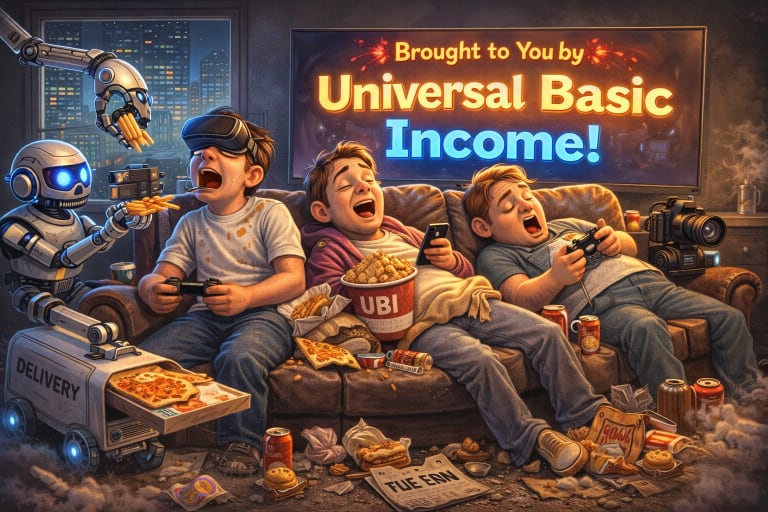
After Work: What's Left in the Post-Labor Economy?
When AI Does the Work, What Do Humans Do With Themselves?
Picture 2029.
GDP is up. The Fed is reporting productivity gains not seen since the Industrial Revolution. Store shelves are full. Services are instant. You can get a custom legal document in 90 seconds, a full marketing campaign in four minutes, and a working software prototype in an afternoon.
The numbers look phenomenal.
Half the people you know don't have traditional jobs.
And here's the part that should keep you staring at the ceiling at 2 AM: the world hasn't collapsed. Not yet. The GDP keeps climbing. The stock market keeps printing. The quarterly reports keep saying things like "record efficiency," "margin expansion," and "operational excellence."
Everything is working.
Except for participation.
That's the quiet horror at the center of this story. We didn't break the economy. We built a version of it that works beautifully for the people still inside it.
We spent two centuries solving the production problem: how to make more things, faster, cheaper, at scale. We nailed it. The tragedy is that we forgot the other equation. Labor was never just about production. It was the mechanism through which ordinary people traded their time and skill for the means to survive.
It was the bridge between humans and the economy.
The bridge is gone.
And nobody, not the economists, not the policymakers, not the tech founders giving TED talks about abundance, has finished building the replacement.
This is Part 3. The part where we stop mapping the collapse and start asking what comes after it.
The Paradox Nobody in Power Will Say Out Loud
Here it is. The economic contradiction that will define the next decade.
Capital doesn't need you to produce anymore.
But it still needs you to consume.
Consumer spending is 70% of U.S. GDP. The top 10% of earners already account for 49% of consumer spending, up from 43% just a few years ago. The economy is already dangerously concentrated at the top.
Now add AI, systematically eliminating the white-collar jobs that generate that spending.
The feedback loop is not theoretical. It's already running. It looks like this:
Companies automate to cut costs, swapping $150,000/year analysts for $15/month compute tokens
Margins spike. Wall Street applauds.
Displaced workers draw down savings
Gig economy safety nets disappear because AI is now doing the freelance writing, coding, and admin work that used to catch people mid-fall
Discretionary spending contracts
Revenue starts shrinking at the very companies that automated themselves in the name of "efficiency."
Boards demand more cuts
Repeat
Oxford Economics found that AI spending boosted U.S. GDP by 0.4 percentage points in 2025, roughly $200 billion in nominal terms.
Impressive number. Look at the footnote.
PwC's April 2026 AI Performance Study found that 74% of AI's economic value is captured by just 20% of organizations, with top performers achieving 7.2x the value of average firms.
So the efficiency gains are real.
The distribution of those gains is catastrophically narrow.
One analyst put the endgame simply: "When you automate the consumer out of a job, you eventually automate the business out of a customer."
That sentence is doing a lot of work. Sit with it.
The Old Contract Is Dead
(And Nobody Called the Funeral)
The deal was simple. Work. Earn. Survive.
Trade your hours for money. Trade money for everything else. This model survived industrialization. It survived the Great Depression. It survived every automation wave that killed entire industries and somehow regenerated new ones on the other side.
It is not surviving this.
Not because the contract was wrong. Because the other party no longer needs to sign it.
So what replaces it? Three serious proposals are on the table. Each has genuine merit. Each has a fatal flaw. None of them is sufficient alone.
Option A: Universal Basic Income
(The Idea That Sounds Simple Until You Read the Data)
UBI has traveled from fringe policy to mainstream necessity conversation with startling speed and for good reason.
Sam Altman ran one of the largest UBI experiments in history, providing payments to 3,000+ participants across Illinois and Texas. The UK government has floated funding UBI through taxes on tech companies. A 2026 UBI analysis covering 122 guaranteed income pilots across 33 U.S. states found that when basic needs are met, financial stress reduces and consumer spending increases.
OpenAI's April 2026 "Industrial Policy for the Intelligence Age" explicitly endorsed a wealth-distribution mechanism for the AI era.
So the evidence is in. UBI works at the level it's designed to address.
Here's the problem.
Across the four largest, most credible studies with 500+ participants in the treatment group, the mean employment effect was -3.2 percentage points.
Translation: UBI stops people from starving. It does not stop people from losing the structure, purpose, social connection, and forward narrative that work provides. You can solve income. You cannot solve existential meaning with a direct deposit.
It turns out those are different problems.
We conflated them for two hundred years because they arrived together in the same paycheck.
Option B: The Abundance Model
(The PowerPoint Looks Great.)
The optimist's argument: AI produces so much that everything gets cheap.
Intelligence is already deflationary; the cost of a language model query has dropped 99% in three years. As AI handles logistics, manufacturing, and services, costs collapse across the board. Money matters less when abundance is the default.
This sounds wonderful until you look at what actually determines the quality of life.
Housing. Land. Healthcare access. Premium education. Desirable geography.
These are not manufactured goods. They're scarce by definition. A world where AI makes laptops and consumer goods nearly free while urban housing costs $5,000 a month is still a world of stratifying inequality, just with cheaper TVs.
Abundance doesn't distribute itself.
It never has.
Option C: The Ownership Economy
(The One Nobody Wants to Build Because It Requires Rethinking Everything)
This is the sleeper idea. The one that doesn't get enough attention because it requires the most radical restructuring of who holds economic claims.
The argument is simple and uncomfortable:
If labor is no longer the mechanism for distributing wealth, then ownership must be.
If you can't earn wages, you need to own what produces them.
Sam Altman has moved beyond UBI to propose Universal Basic Compute (UBC), giving every person a stake in AI capacity so that as AI generates economic value, individuals with compute stakes benefit directly.
The policy implication: treat national AI infrastructure like a sovereign wealth fund. The way Norway treats oil revenue.
Countries are beginning to experiment with this framing.
The question is whether they move fast enough for it to matter or whether the infrastructure gets locked up inside private data centers before the legislation even gets a committee hearing.
What's Actually Emerging: Universal Basic Services
The 2026 trend from pilots in Northern Europe isn't a clean UBI or a pure ownership economy.
It's Universal Basic Services: free infrastructure transit, broadband, AI-assisted healthcare, layered with "Participation Income" that compensates people for community contributions AI cannot perform.
It's less elegant than a single clean solution.
It's probably more honest about the actual problem.
Reality check: We built two centuries of economic infrastructure on one assumption that human labor was the engine. That assumption is now wrong. The infrastructure hasn't caught up. We're running a 2029 economy on a 1950s operating system and calling it a transition.
Let's Stop Being Polite About This
(What Is Actually Left for Humans to Do?)
If AI handles analysis, writing, coding, logistics, customer service, legal review, financial modeling, and increasingly clinical diagnosis, what is genuinely left?
Three categories hold up under real scrutiny. Not wishful thinking. Not "humans will always be creative." Actual structural resistance.
Category 1: Human Experience Work
Live performance. In-person coaching. Community building. Events. Art. Craft. Food. Ritual. Relationships.
Not because AI can't approximate these things, it can and will, but because humans demonstrably prefer humans for experiences that carry emotional weight.
People will pay more for a dinner cooked by a human they know than for algorithmically optimized nutrition delivery. People will pay for concerts they could stream for free. They will pay for a therapist when an AI chatbot would technically deliver better cognitive-behavioral therapy outputs at 2 AM for free.
The emotional authenticity signal isn't nostalgia.
It's a core feature of human psychology that becomes more valuable, not less, in a world saturated with AI-generated everything.
When everything is synthetic, authenticity becomes a luxury good.
Category 2: Trust-Critical Roles
Doctors still sign off. Lawyers still review. Executives still make decisions.
This isn't because humans are better at these tasks. Increasingly, they aren't. It's because legal accountability requires a body, and a body requires a human.
Harvard Law's analysis of AI oversight found that regulations keep mandating human sign-off while completely failing to grapple with whether those humans have the bandwidth to exercise meaningful review.
The oversight layer stays. The layer keeps thinning. The stakes keep rising every time it fails.
This is not a comfortable equilibrium. It's a liability arrangement dressed up as governance.
Category 3: Status and Identity Work
Here's the uncomfortable one.
When work becomes optional, it becomes tribal.
Expertise that used to be functional becomes a signal. The independent craftsman, the human therapist, the chef who sources everything locally, these aren't priced on labor value anymore. They're priced on authenticity and scarcity.
Work becomes less about income and more about identity performance.
Which leads to a prediction that should genuinely make you pause:
We are about to witness the strangest expansion of status competition among humans in recorded history.
When the baseline is AI-generated everything, the human-made becomes the artifact. The hand-thrown pot. The essay was written without assistance. The coach who actually lived through what you're facing.
You know where this goes.
Entire aesthetic movements will emerge around provable humanity. Already are.
The Real Truth
(This Is the One the Economic Models Skip.)
You can solve income. You cannot solve this with money.
Work, for most people in the modern world, provides five things simultaneously:
Income
Structure
Social connection
Status and identity
A forward narrative a reason to exist beyond biology
The World Economic Forum has explicitly flagged the emerging "AI precariat" not just economically displaced people, but a global cohort experiencing what the WEF calls "occupational identity loss": the simultaneous collapse of purpose, social belonging, and self-narrative that comes when work disappears.
This isn't a side effect.
It's the main event.
COVID gave us a preview. It wasn't reassuring.
During lockdowns, people received financial support. They avoided commutes. They recovered hours. Mental health facility use increased by 18% in regions with lockdowns, compared with a 1% decline in regions without them. Stress, depression, and "reaction to severe stress" diagnoses spiked across every demographic.
People had money. People had time.
What they didn't have was the sense of being needed.
And that gap was devastating.
The Finland UBI pilot data from 2026 confirms the pattern at scale: when basic needs are met, people pivot toward arts, philosophy, and community roles. The human-centric contributions. That's the encouraging part.
The less encouraging part: it describes a world where meaning must be actively constructed rather than delivered automatically by the economy.
Most people are not prepared for that responsibility.
Most people have never had to be.
Translation: We are about to hand billions of people unlimited free time and no instruction manual. The mental health infrastructure doesn't exist. The cultural frameworks aren't built. The education system is designed to produce employees, not philosophers.
"Humans don't just need income. They need to feel needed."
The psychosocial collapse that follows large-scale role loss is not a policy problem.
It's a civilization problem.
And unlike the production problem, there is no software update that fixes it.
The New Hierarchy
(Status After Salaries)
If money becomes less tied to survival, what determines status?
Younger workers are already showing the shift. A 2026 profile of workplace attitudes found that young employees increasingly don't define themselves by job titles, experiencing layoffs as "a transition between expressions of their capability, not as a collapse of self."
The identity-from-employment assumption is weakening.
Slowly. Unevenly. But measurably.
In its place, five signals are emerging as the new status architecture:
Influence audience, reach, and the size of the attention you command
Ownership of AI systems, equity stakes, and assets that generate value while you sleep
Taste curation over creation; the ability to separate signal from noise at scale
Access networks, communities, relationships that can't be purchased on a platform
Craft visibly human output in a world of AI-generated everything
In a post-work world, status becomes the new currency.
But it's more subjective, more psychological, and potentially more unequal than salary ever was.
At least wages had numbers.
Status hierarchies don't. And the people who are best at the game of visibility and influence, already a profoundly unfair game, are about to gain leverage that no employment contract could have generated.
The social stratification isn't coming.
It's already printing.
What's Actually Worth Building
For anyone who wants to be on the right side of what's coming, here's where the real opportunity lives.
AI Leverage Businesses
The one-person company is no longer a lifestyle brand. It's becoming a real economic category.
Solo founders using AI agents are already demonstrating that small teams generate disproportionate output. AI agents handle 80–85% of execution at 2–5% the cost of a traditional team.
At GTC 2026, Jensen Huang revealed that NVIDIA internally runs 100 AI agents per human employee.
Read that ratio.
Sam Altman has predicted that the first billion-dollar solo startup will launch by 2028. In China, "One Person Companies" using AI saw explosive growth in early 2026, with 92% of highly profitable OPCs deeply integrating AI tools.
The organizational unit of capitalism is changing. The new atom is one person with the right stack.
Ownership Platforms
Tools that give people real control over the intelligence layer: local AI models, personal data infrastructure, and AI identity systems.
Part 2 of this series argued: own your inference, don't rent it.
The Part 3 implication: build platforms that let others own theirs.
The person who builds the sovereignty layer, the infrastructure that enables AI independence, is positioned fundamentally differently than the person renting compute from a hyperscaler at this quarter's price.
Human-Centric Products
Community. In-person experience. Accountability relationships.
These are deflationary-proof.
You cannot AI-generate the feeling of belonging to something real. Coaching, peer groups, ritual, craft, and live experience these appreciate in perceived value as the ambient world fills with synthetic content.
The market for genuine human connection is about to become the most counterintuitively premium market in the economy.
Trust Infrastructure
Verification layers. AI audit systems. Proof-of-human authentication.
Every institution deploying AI agents needs a trust layer beneath it. The EU AI Act, which mandates human oversight for high-risk systems starting in August 2026, establishes explicit regulatory requirements.
The company that builds credible oversight infrastructure not as compliance theater, but as genuine trust architecture, has a moat that no model update can erase.
Psychology and Meaning Systems
When survival is solved, psychology becomes the market.
Coaching, structured life design, purpose platforms, and community belonging as a product. This sounds soft until you notice that mental health tech is already growing 20%+ annually, and that's before the large-scale meaning crisis from AI displacement has fully hit.
The market for helping people construct purpose in a post-work context is enormous.
It is almost completely unbuilt.
That is not an oversight. It's an opening.
Three Paths Forward
(Pick One. Probably Need All Three.)
Path 1 The Operator
You use AI to stay economically relevant. Relentlessly. Ruthlessly. Without sentimentality.
You don't do tasks. You own workflows. You don't produce output. You direct systems.
Every morning, the question is: what part of my current function could be done better, faster, and cheaper by an AI agent, and how do I capture that efficiency before someone else uses it to replace me entirely?
This path keeps you in the game. It does not answer the deeper question.
Path 2 The Owner
You build or acquire systems that generate value without your direct labor.
A business with AI agents at its core. Equity in companies building the intelligence layer. Infrastructure that compounds while you sleep.
The Owner isn't necessarily technical. They understand that the game has shifted from doing to owning what does.
This path builds wealth. It also does not answer the deeper question.
Path 3 The Human
You lean entirely into what cannot be replicated.
Deep relationships. Trusted judgment. Irreplaceable presence. The therapist, the mentor, the trusted advisor, the community anchor, the craftsman who makes things slowly and well.
This path carries real economic risk in the short term.
It may have the highest human value and, in the long term, the highest economic value, as authentic human connection becomes genuinely scarce in a world where everything else is on demand and synthetic.
Most people will need to operate across all three paths simultaneously, at different ratios, in different phases.
The mistake the expensive one is picking only one and holding.
The Question Nobody Can Answer Yet
(And the Ones We Have to Ask Anyway)
We spent two hundred years trying to make humans more productive.
We built institutions around it. Incentive structures. Education systems. Social contracts. All of it was organized around the premise that human effort was the engine and that the engine needed to be trained, optimized, and pointed in productive directions.
Now the engine has a replacement.
And we have to figure out what humans are for when productivity no longer requires us.
That is not a technological problem.
It is not an economic problem.
It is a civilizational problem, the kind that takes generations to work through, not product cycles.
The agricultural-to-industrial transition took decades and caused genuine, serious human suffering before new equilibria formed. The manufacturing-to-services transition took decades and left entire regions economically gutted before new industries moved in.
This one is playing out in years.
The institutions designed to help people navigate governments, universities, and labor organizations are running decades behind the technology. The social safety nets were engineered for unemployment as a temporary condition, not as a permanent structural feature of an AI-first economy.
We didn't just automate work.
We automated the question that came with it.
What do we do now?
And nobody, not the economists, not the technologists, not the policymakers, not the AI labs funding think tanks, to argue about alignment while quietly eliminating entry-level hiring has a clean answer.
The machines got there first.
We're still working it out.
The Mic Drop
Parts 1 and 2 of this series mapped the collapse of the old economy.
Part 3 is when you realize we haven't finished building the new one.
The Last Economy isn't a phase we enter and exit.
It's a brutal, ongoing, and happening renegotiation, whether or not the political conversation is ready for it.
The people who adapt will not be those who wait for guidance from institutions structurally incapable of moving fast enough. They'll be the ones who paid attention to the signals early, built leverage before it was obvious, and understood that the window between "coming disruption" and "disruption that already happened to you" is measured in months, not years.
The economy doesn't need you to produce.
The question is whether you've decided what you need.
Because the answer that used to arrive automatically in the form of a job offer and a paycheck is now something you have to build yourself.
Nobody's sending the memo.
The meeting has already started.
Part 3 of The Last Economy series. Part 1 covered the cost delta and the end of the old employment contract. Part 2 mapped the 24-month transition timeline. Part 4 examines who is actually building the replacement: the founders, the governments, and the institutions racing to define the new contract before the old one finishes collapsing.